

Explore the Research
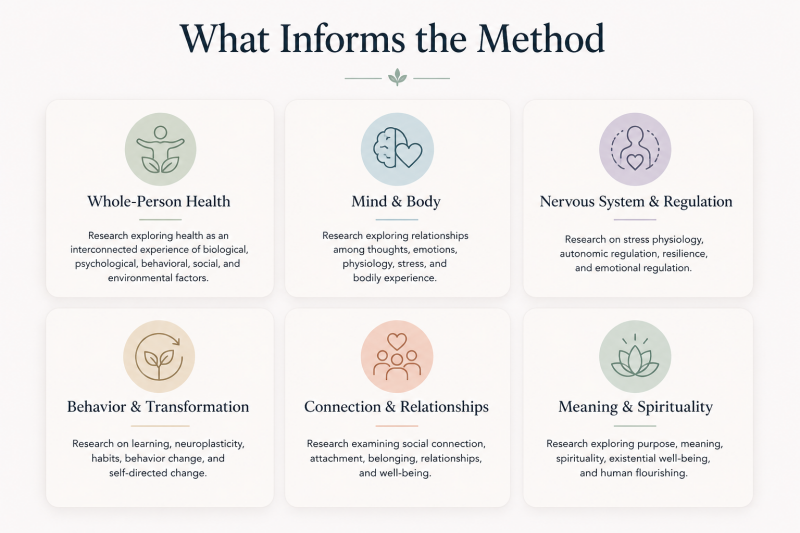
1. Whole-Person Health
Research explores how biological, psychological, behavioral, social, and environmental factors interact to influence health and well-being. Whole-person health is increasingly recognized as an important area of research, including approaches that address multiple interconnected dimensions of health.
https://www.nccih.nih.gov/health/whole-person-health-what-it-is-and-why-its-important?utm_source
Research takeaway:
Health is influenced by interconnected systems, not isolated parts of the person.
2. Mind & Body
Research explores the relationships among thoughts, emotions, attention, stress, physiology, and bodily experience. Mindfulness and other mind-body practices have been studied for their effects on stress, anxiety, sleep, and other aspects of well-being.
https://www.nccih.nih.gov/health/stress?utm_source
Research takeaway:
Mental and physical experiences continuously interact.
3. Awareness & Interoception
Research examines how people sense, interpret, and respond to internal bodily signals, including sensations associated with emotions and physiological states.
https://pubmed.ncbi.nlm.nih.gov/32849058/
Research takeaway:
Developing awareness of internal experience may support emotional awareness and regulation.
4. Nervous System & Regulation
Research examines stress physiology, autonomic regulation, emotional regulation, resilience, and the body's responses to perceived stress and safety.
https://pubmed.ncbi.nlm.nih.gov/32886587/
Research takeaway:
The capacity to regulate stress is an important part of psychological and physiological well-being.
5. Self-Compassion & Emotional Well-Being
Research has examined how self-compassion relates to emotion regulation and mental health, with systematic reviews identifying emotion regulation as one potential pathway through which self-compassion may influence well-being.
https://pubmed.ncbi.nlm.nih.gov/29673093/
Research takeaway:
How we relate to ourselves may influence how we process and regulate difficult experiences.
6. Behavior & Transformation
Research examines learning, habit formation, neuroplasticity, behavioral patterns, and the processes through which repeated experiences can influence future behavior.
https://pubmed.ncbi.nlm.nih.gov/39685110/
Research takeaway:
Lasting change involves learning and repeated experiences, not simply gaining new information.
7. Connection & Relationships
Research consistently links the quality and strength of social relationships with health and longevity. A major meta-analysis of 148 studies involving more than 308,000 people found stronger social relationships were associated with greater likelihood of survival.
https://pubmed.ncbi.nlm.nih.gov/20668659/
Research takeaway:
Connection is an important dimension of human health and well-being.
8. Purpose, Meaning & Spirituality
Research explores how purpose, meaning, spirituality, and existential well-being relate to health and human flourishing. A 2026 meta-analysis involving 488,765 participants found a consistent association between greater purpose in life and lower mortality risk, although the researchers emphasize that the relationship is not entirely causal.
https://pubmed.ncbi.nlm.nih.gov/42417009/
Research takeaway:
A sense of purpose and meaning is associated with important dimensions of well-being and health.
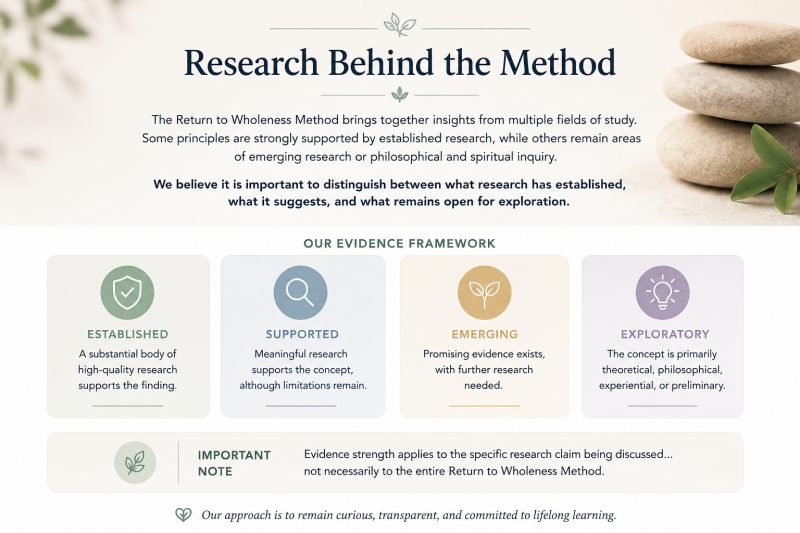
Our Approach to Evidence
Curiosity with discernment.
Return to Wholeness honors both scientific inquiry and human experience. We distinguish between established evidence, emerging research, theoretical frameworks, and philosophical or spiritual perspectives.
Our goal is not to make science prove a philosophy. It is to remain curious about what research can teach us about the interconnected nature of human experience while being transparent about what we know, what we are learning, and what remains unknown.